In the intense environment of a professional kitchen, heat is the most valuable resource. For decades, the roar of a traditional open fire burner has been the soundtrack of busy restaurants across India. However, as operational costs rise and technology evolves, many business owners are questioning if the old ways are still the best ways. The debate between traditional fire setups and modern high efficiency gas burners is not just about cooking; it is about the bottom line, kitchen safety, and consistent food quality.
To make an informed decision for your establishment, it is essential to understand how these two technologies stack up against each other in a real world industrial setting.
The Legacy of Traditional Fire Burners
Traditional burners, often referred to as high pressure burners in many Indian commercial setups, have been the industry standard for a reason. They are simple, rugged, and capable of producing massive amounts of heat instantly.
- Reliability and Simplicity: These burners have very few moving parts. They are easy for local technicians to repair and can handle the rough use common in high volume catering and roadside eateries.
- Intense Heat for Specific Techniques: For dishes that require “wok hei” or the characteristic char of a high flame, traditional burners provide the raw power needed to sear meats and vegetables in seconds.
- Low Initial Cost: Setting up a kitchen with traditional burners is generally cheaper upfront. The hardware is widely available and requires less sophisticated installation compared to high efficiency systems.
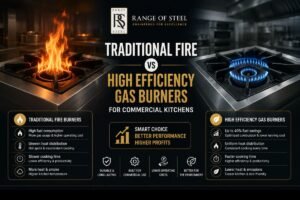
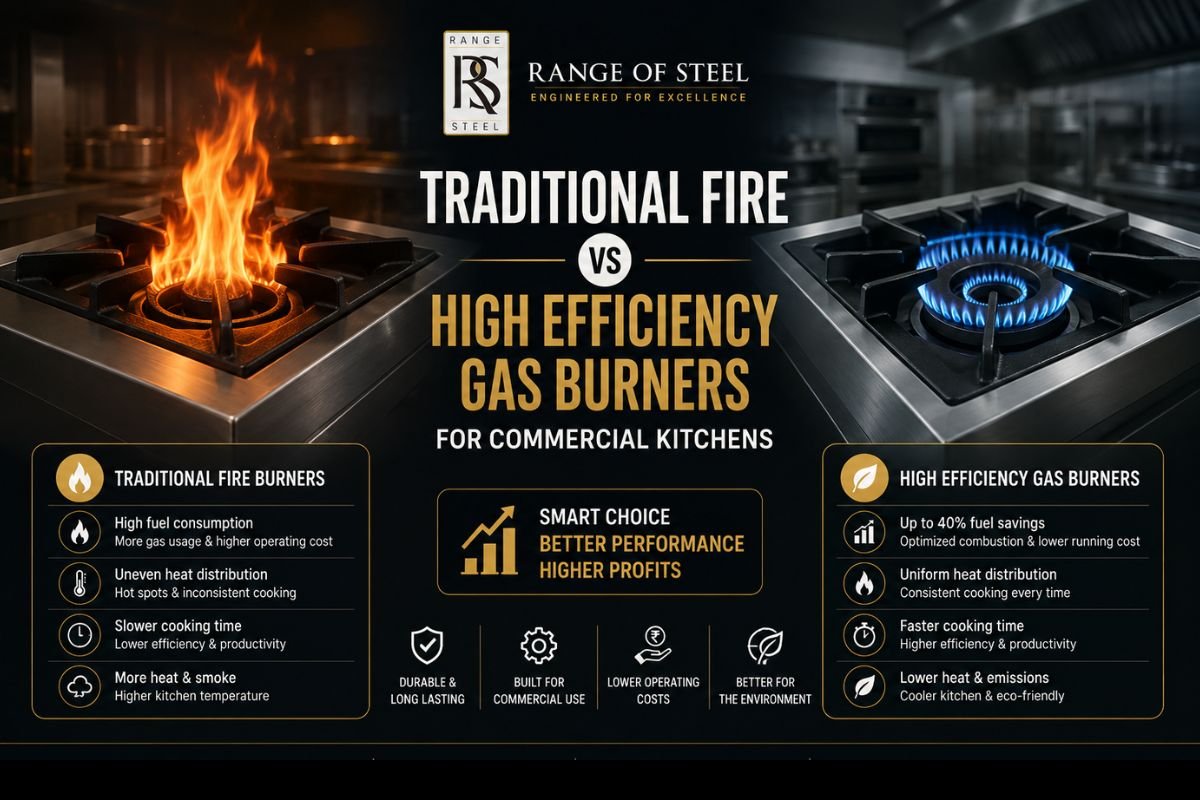
However, the downside is often found in the waste. Much of the heat generated by a traditional open flame escapes into the kitchen environment rather than being absorbed by the cooking vessel. This leads to higher gas consumption and a much hotter, more uncomfortable working environment for the chefs.
The Shift to High Efficiency Gas Burners
High efficiency burners are engineered to solve the problem of heat loss. Instead of just producing a large flame, these burners are designed to optimize the air to fuel ratio and direct the energy exactly where it is needed: the bottom of the pan.
- Reduced Fuel Consumption: On average, a high efficiency burner can reduce gas usage by 20 to 30 percent. Over a year of full time operation, these savings can significantly impact a restaurant’s profitability.
- Focused Heat Distribution: These burners often feature specialized head designs, such as V shape or multi ring patterns, that ensure the flame remains stable and concentrated. This leads to faster boiling times and more uniform cooking.
- Improved Kitchen Comfort: Because less heat is wasted into the air, the ambient temperature of the kitchen stays lower. This reduces the load on your ventilation and air conditioning systems, further saving on electricity costs.
Comparing Operational Speed
In a commercial kitchen, speed is everything. Traditional burners are fast because of their sheer volume of fire, but high efficiency burners are fast because of their precision.
While a traditional burner might take longer to heat a large stock pot due to heat escaping around the sides, a high efficiency burner focuses the thermal energy, often reaching the desired temperature in less time despite using less total gas. For a busy kitchen handling hundreds of orders, these saved minutes add up to faster table turnover.
Durability and Maintenance
A common concern among restaurant owners is whether modern high efficiency burners can handle the “heavy lifting” of an Indian kitchen.
Traditional burners are famous for being indestructible. You can spill gravies, drop heavy pots, and subject them to constant moisture with little worry. High efficiency burners, while also made of durable materials like cast iron or high grade stainless steel, require a bit more care. The precision nozzles and air mixing chambers need to be kept clean to maintain their efficiency ratings. If they are neglected and become clogged with grease, their performance advantage quickly disappears.
Safety and Compliance
Modern high efficiency systems often come with better safety features. Many are designed to operate with lower carbon monoxide emissions, which is crucial for the health of your kitchen staff. In enclosed kitchen spaces with limited ventilation, the cleaner combustion of a high efficiency burner is a major advantage. Furthermore, as fire safety regulations in India become stricter, equipment that offers better flame control and lower ambient heat radiation is increasingly preferred by inspectors.
The Financial Verdict
When choosing between the two, you have to look at the total cost of ownership.
- Choose Traditional Burners if: You are running a small scale startup, a temporary catering business, or a kitchen where the menu depends entirely on high flame techniques that modern burners might struggle to replicate.
- Choose High Efficiency Burners if: You are looking at a long term business model. The higher initial investment is usually recovered within 6 to 12 months through lower gas bills. They are the better choice for hotels, cloud kitchens, and restaurants that operate 12 to 18 hours a day.
Conclusion
The transition from traditional fire to high efficiency gas burners reflects the broader trend of modernization in the Indian food industry. While there will always be a place for the raw power of a traditional flame, the future belongs to equipment that does more with less.
By investing in high efficiency burners, you are not just buying a piece of cooking equipment; you are investing in a cooler kitchen, a lower carbon footprint, and a more sustainable business model. For the modern restaurateur, the choice is clear: efficiency is the key to scaling success in a demanding market.